
Kathmandu University (KU) Evaluation Scheme Breakdown
A detailed look at how KU grades its students across Schools of Science, Engineering, and Management.
Kathmandu University (KU) follows a robust grading system compliant with international standards. The evaluation is continuous, meaning your internal assessments, quizzes, and projects contribute significantly to your final grade, not just the end-semester exam.
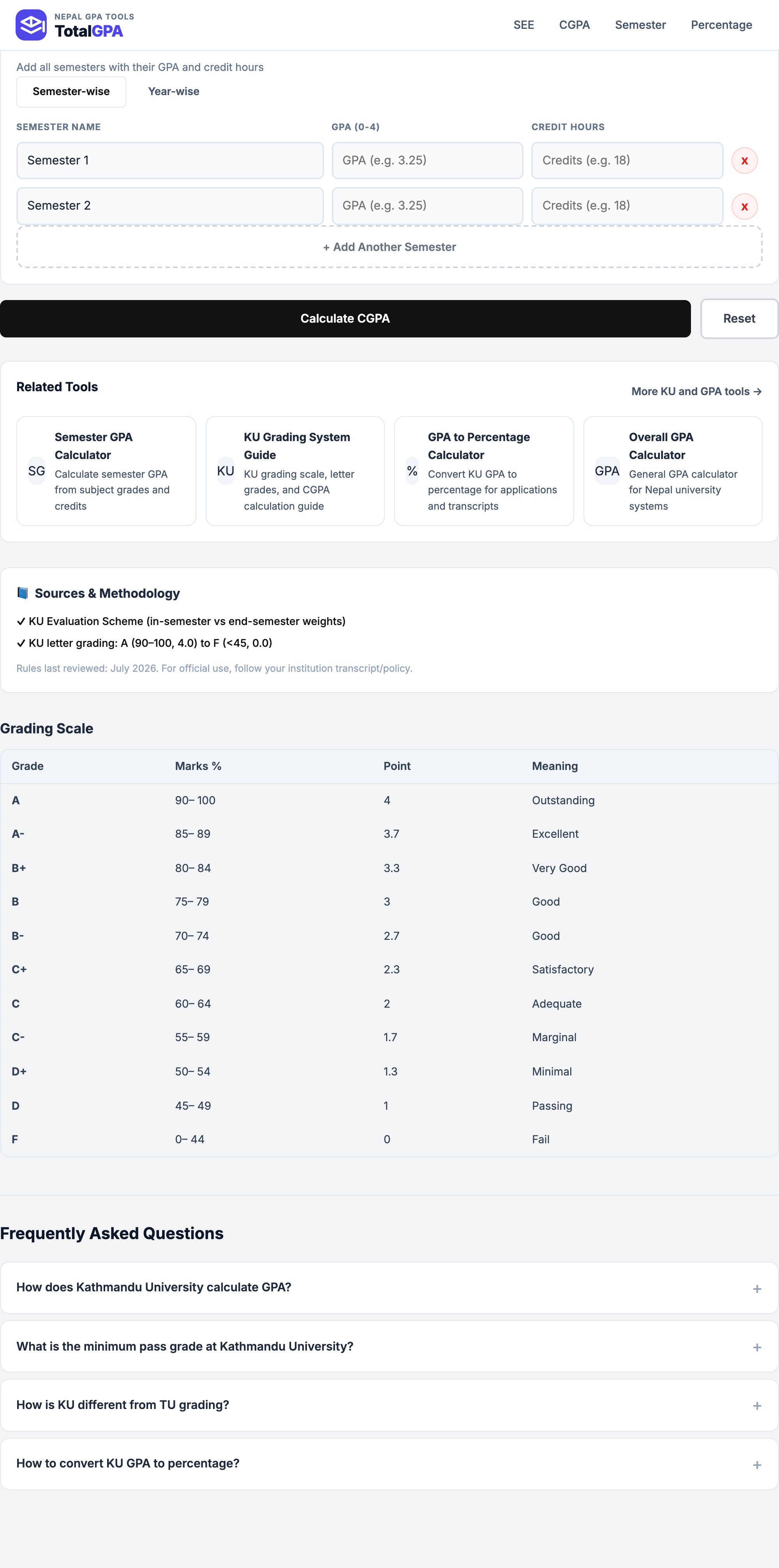
KU Grading Scale
KU uses a 4.0 grading scale. The conversion from percentage to grade varies slightly by school, but the general framework is:
| Grade | Grade Point | Description |
|---|---|---|
| A | 4.0 | Outstanding |
| A- | 3.7 | Excellent |
| B+ | 3.3 | Very Good |
| B | 3.0 | Good |
| B- | 2.7 | Fair |
| C+ | 2.3 | Satisfactory |
| C | 2.0 | Sufficient |
| C- | 1.7 | Poor (Non-Credit) |
| F | 0.0 | Fail |
Marks Distribution
Typically, specific weightage is assigned to internal and external evaluations:
- Internal Assessment: 50% (Assignments, Quizzes, Projects, Mid-Term)
- End-Semester Exam: 50%
Note: This distribution can vary depending on the course and instructor.
GPA, CGPA and Honours Planning
The GPA is calculated for each semester. The CGPA (Cumulative GPA) is the weighted average of GPAs from all semesters. To graduate, students generally need a minimum CGPA of 2.0 to 2.5 depending on the program.
For honours, scholarships, graduate applications, and competitive internships, KU students usually need a consistently strong CGPA. A CGPA above 3.5 is a useful planning benchmark, but each school or scholarship may publish its own cutoff.
How to Estimate KU CGPA Correctly
- Collect your official grade sheet for each semester with credit hours.
- Multiply each course grade point by its course credits.
- Add all quality points and divide by total attempted credits.
- Recheck repeated courses using your school's latest repeat policy.
Worked example: if a semester has 18 credits and total quality points of 59.4, GPA is 59.4 ÷ 18 = 3.30. Repeat this semester-wise and then compute cumulative totals for final CGPA. This is more accurate than averaging semester GPA values directly when credits differ.
Disclaimer: KU schools may apply different course structures, repeat-grade rules, and honours criteria. Always confirm the latest official handbook and examination notice before final transcript or scholarship submission.