
Marks to GPA Conversion Guide for Nepal Students
Learn how to convert your subject marks to GPA for NEB, TU, KU, Pokhara & Purbanchal University – with examples and free calculator.
Converting marks to GPA is a common requirement for Nepal students, whether you're applying for scholarships, higher studies abroad, or just want to understand your academic standing. This complete guide explains how all major Nepal education boards and universities convert marks to GPA.
Understanding the GPA System in Nepal
GPA (Grade Point Average) is a standardized way to represent academic performance on a scale, typically 4.0 in Nepal. Instead of showing raw marks (like 85/100), GPA shows your performance as:
- 4.0 GPA = Exceptional (90-100%)
- 3.6 GPA = Excellent (80-89%)
- 3.2 GPA = Very Good (70-79%)
- 2.8 GPA = Good (60-69%)
How Marks are Converted to GPA (The Process)
The conversion happens in 3 steps:
Percentage = (Theory + Practical) / Total Full Marks × 100
Step 2: Map percentage to grade using grading scale
Example: 85% → Grade A
Step 3: Assign grade point to the grade
Example: Grade A → 3.6 points
Step 4: Calculate weighted average using credit hours
GPA = Σ(Grade Point × Credits) / Σ(Credits)
Marks to GPA Conversion: NEB (SEE & Class 12)
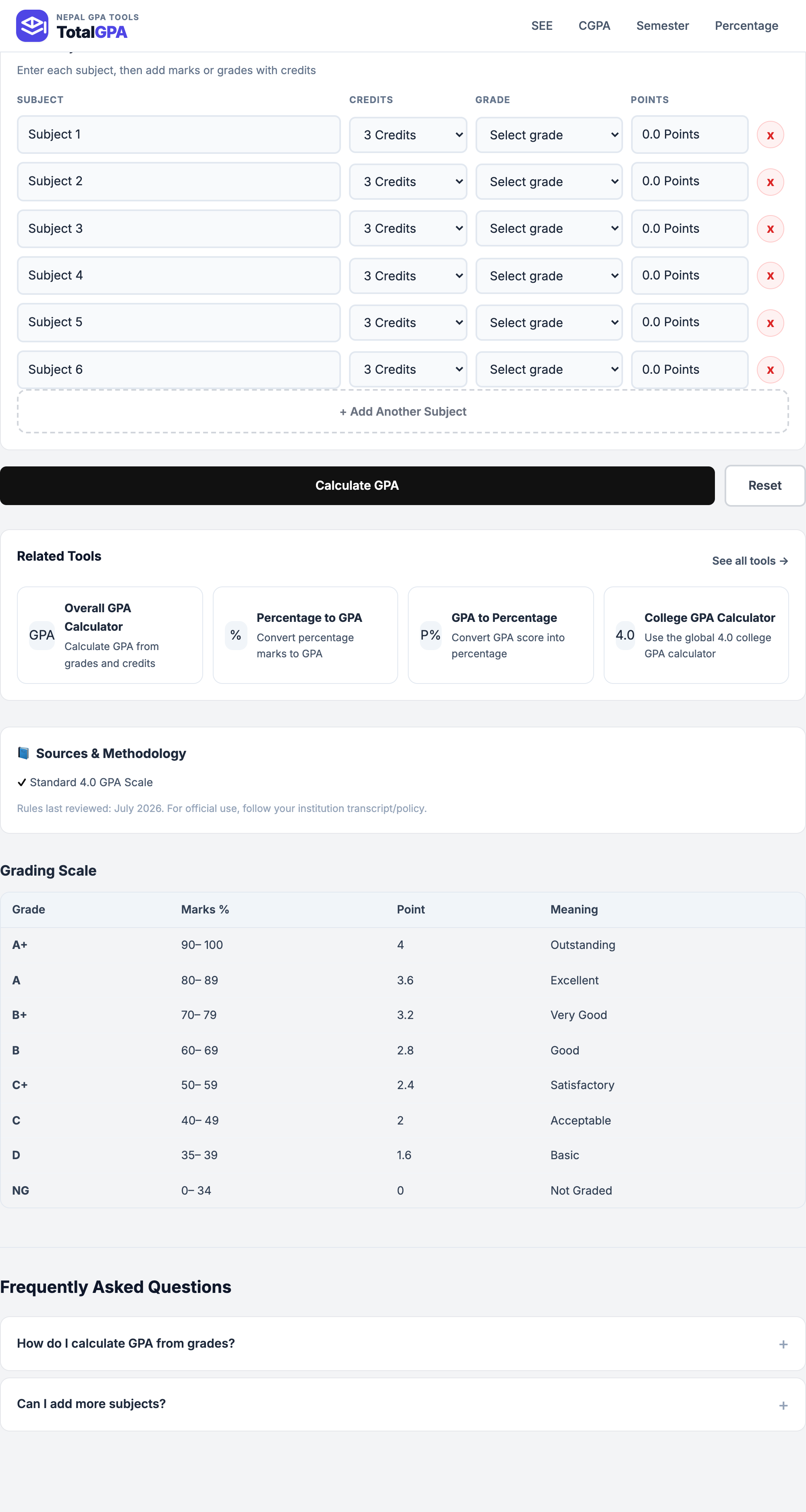
The National Examinations Board (NEB) uses the following conversion table for SEE and +2 students:
| Marks Range (%) | Letter Grade | Grade Point | Remark |
|---|---|---|---|
| 90 - 100 | A+ | 4.0 | Outstanding |
| 80 - 89 | A | 3.6 | Excellent |
| 70 - 79 | B+ | 3.2 | Very Good |
| 60 - 69 | B | 2.8 | Good |
| 50 - 59 | C+ | 2.4 | Satisfactory |
| 40 - 49 | C | 2.0 | Acceptable |
| 35 - 39 | D | 1.6 | Basic |
| Below 35 | NG | 0.0 | Not Graded |
Example: Converting SEE Marks to GPA
Let's say you got these marks in SEE:
• English: Theory 60/75, Practical 20/25 = 80/100 = 80% → A (3.6) × 5 credits = 18.0
• Nepali: Theory 65/75, Practical 18/25 = 83/100 = 83% → A (3.6) × 5 credits = 18.0
• Math: 88/100 = 88% → A (3.6) × 5 credits = 18.0
• Science: Theory 68/75, Practical 22/25 = 90/100 = 90% → A+ (4.0) × 5 credits = 20.0
• Social: Theory 55/75, Practical 19/25 = 74/100 = 74% → B+ (3.2) × 4 credits = 12.8
• HPE: Theory 62/75, Practical 23/25 = 85/100 = 85% → A (3.6) × 4 credits = 14.4
• Computer: Theory 45/50, Practical 42/50 = 87/100 = 87% → A (3.6) × 3 credits = 10.8
• Optional: Theory 58/75, Practical 20/25 = 78/100 = 78% → B+ (3.2) × 4 credits = 12.8
Total Quality Points: 124.8
Total Credits: 35
GPA: 124.8 ÷ 35 = 3.57
Marks to GPA: Tribhuvan University (TU)
TU follows a slightly different grading scale for semester system (BBS, BCA, BSc CSIT, etc.):
| Marks % | Grade | Grade Point |
|---|---|---|
| 90 - 100 | A | 4.0 |
| 80 - 89 | A- | 3.7 |
| 70 - 79 | B+ | 3.3 |
| 60 - 69 | B | 3.0 |
| 55 - 59 | B- | 2.7 |
| 50 - 54 | C+ | 2.3 |
| 45 - 49 | C | 2.0 |
| 40 - 44 | D | 1.7 |
| Below 40 | F | 0.0 |
Key Difference: TU has more granular grading (A-, B-, C+) compared to NEB. This means your GPA can be more precise.
Marks to GPA: Kathmandu University (KU)
KU uses a similar 4.0 scale with slight variations:
| Grade | Grade Point | Description |
|---|---|---|
| A | 4.0 | Outstanding |
| A- | 3.7 | Excellent |
| B+ | 3.3 | Very Good |
| B | 3.0 | Good |
| B- | 2.7 | Fair |
| C+ | 2.3 | Satisfactory |
| C | 2.0 | Sufficient |
| F | 0.0 | Fail |
Marks to GPA: Pokhara University & Purbanchal
Both universities follow a similar 4.0 scale system:
- 90-100%: A (4.0)
- 85-89%: A- (3.7)
- 80-84%: B+ (3.3)
- 75-79%: B (3.0)
- 70-74%: B- (2.7)
- 65-69%: C+ (2.3)
- 60-64%: C (2.0)
- Below 45%: F (0.0)
Quick Conversion: Common Marks to GPA
Here's a quick reference for common percentage marks:
95% → 4.0 GPA | 85% → 3.6 GPA | 75% → 3.2 GPA | 65% → 2.8 GPA | 55% → 2.4 GPA
TU Scale:
95% → 4.0 GPA | 85% → 3.7 GPA | 75% → 3.3 GPA | 65% → 3.0 GPA | 55% → 2.7 GPA
Important Things to Remember
- Different institutions use different scales: Always use the correct grading scale for your board/university.
- Credit hours matter: GPA is a weighted average. A 3-credit subject affects your GPA less than a 5-credit subject.
- Theory/Practical split: For subjects with theory and practical, add them first, then convert to percentage.
- NG/F grades count as 0.0: A single failed subject significantly lowers your overall GPA.
- Round carefully: Most systems use 2 decimal places (e.g., 3.54, not 3.5).
Use Our Free GPA Calculator
Instead of calculating manually, use our free tool that supports all Nepal grading systems:
Common Questions
Q: Can I convert my old marksheet to GPA?
Yes! Even if your original certificate doesn't show GPA, you can convert it using the grading scale that was in effect during your study period. Universities accept this conversion for applications.
Q: My marks are in absolute numbers (like 85/100). How do I calculate GPA?
First convert to percentage (85/100 = 85%), then use the grading scale to find the grade point. If you have multiple subjects, calculate weighted average using credit hours.
Q: What if my subject has different full marks (like 80 or 120)?
Always convert to percentage first: (Your Marks / Full Marks) × 100. Then use the percentage to find the grade point.
Q: Is GPA calculation the same for all faculties in TU?
The grading scale is the same, but credit hour distribution may differ between faculties (BBS, BCA, BBM, etc.). Always check your course curriculum for correct credit hours.
Conclusion
Converting marks to GPA in Nepal is straightforward once you know which grading scale to use. Whether you're a NEB student, TU student, or from KU/Pokhara/Purbanchal, the process is similar: percentage → grade → grade point → weighted average.
Use our free calculator to get accurate results instantly, and save time on manual calculations!
Related Tools:
- GPA Calculator – Calculate GPA from grades and credits
- SEE GPA Calculator – For NEB Grade 10 students
- Percentage to GPA – Quick percentage conversion
- TU Semester GPA – For Tribhuvan University students