
Pokhara University CGPA Calculation Method
A comprehensive guide to how Pokhara University (PU) calculates student grades.
Pokhara University (PU) employs a standard 4.0 grading system similar to international universities. The evaluation is based on a credit-hour system where each course carries a certain weight.
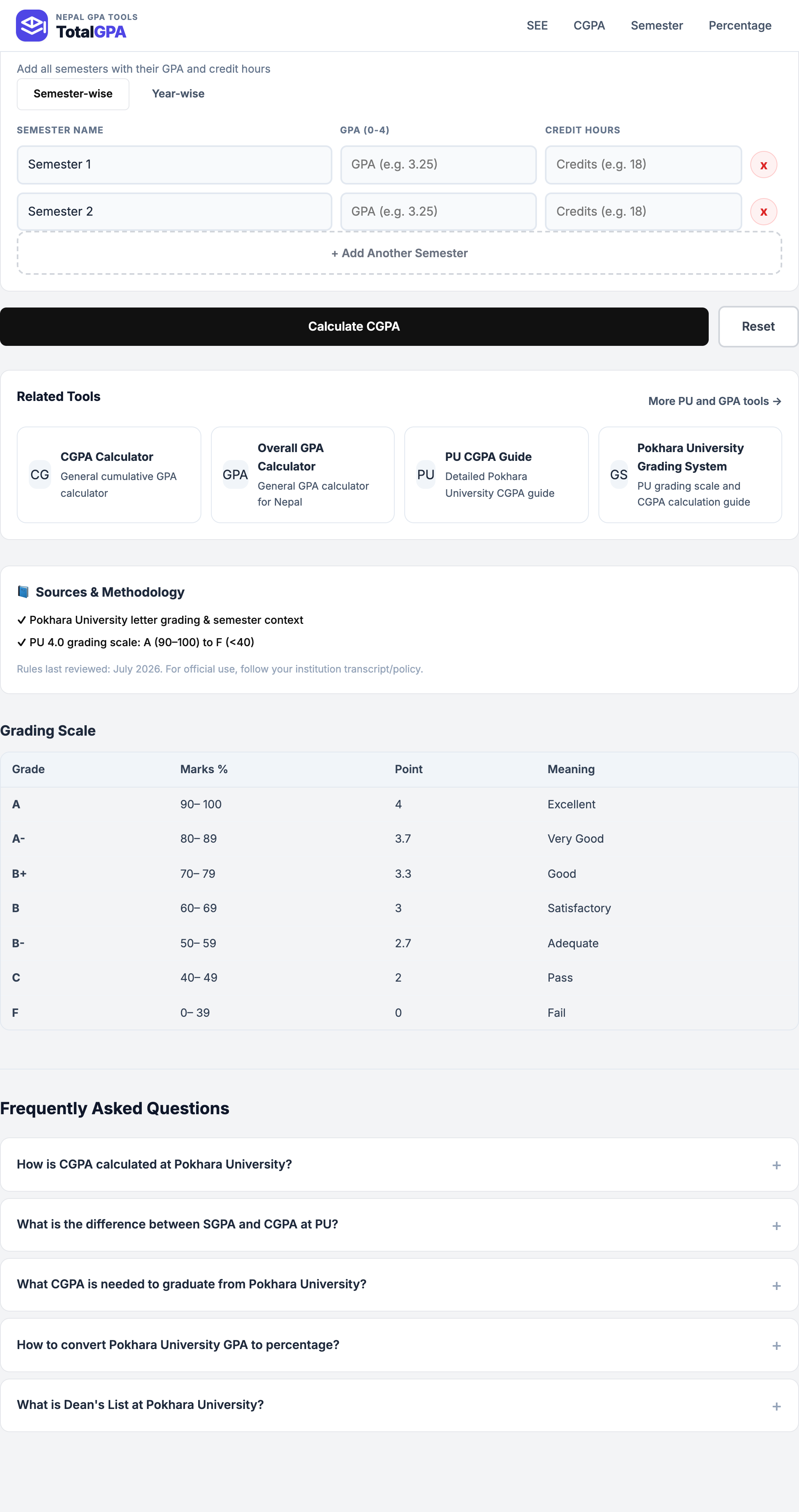
Grading Performance Scale
PU evaluates performance using letter grades derived from percentage scores. Here is the standard breakdown for undergraduate programs:
| Letter Grade | Grade Point | Marks Range | Description |
|---|---|---|---|
| A | 4.0 | 90 - 100 | Excellent |
| A- | 3.7 | 85 - 89 | Very Good |
| B+ | 3.3 | 80 - 84 | Good |
| B | 3.0 | 75 - 79 | Fair |
| B- | 2.7 | 70 - 74 | Satisfactory |
| C+ | 2.3 | 65 - 69 | Satisfactory |
| C | 2.0 | 60 - 64 | Acceptable |
| F | 0.0 | Below 45 | Fail |
SGPA vs CGPA
SGPA (Semester Grade Point Average) is calculated for a single semester.
SGPA = Total Grade Points in Semester / Total Credits in Semester
CGPA (Cumulative Grade Point Average) is the average of all semesters completed so far.
CGPA = Total Grade Points Obtained (All Semesters) / Total Credits Attempted (All Semesters)
Dean's List
Students with outstanding academic performance (typically a CGPA of 3.7 or higher) may be eligible for the Dean's List, a prestigious recognition of academic excellence at Pokhara University.
How to Calculate PU CGPA Step by Step
- Write each subject with its credit hour from your PU result sheet.
- Convert letter grades to grade points for every course.
- Multiply grade point by credit hour to get quality points.
- Add all quality points and divide by total completed credits.
Worked example: if total quality points from completed semesters are 244 and total credits are 74, then CGPA = 244 ÷ 74 = 3.30. For admission or scholarship forms, use official transcript CGPA first and percentage only as supplementary conversion.
Disclaimer: Some PU programs can have updated grading notices, repeat rules, or special practical assessment policy. Always verify with your campus exam section before final document submission.
Common mistakes include mixing grade boundaries from other universities, skipping low-credit backlog subjects in totals, and using plain semester averages instead of credit-weighted cumulative values. Recalculate from the full transcript before final applications.