
How to Calculate CGPA for TU BSc CSIT Students
Comprehensive guide to Tribhuvan University Bachelor of Science in Computer Science and Information Technology (BSc CSIT) GPA and CGPA calculation.
This guide explains the weighted SGPA and CGPA calculation method for TU BSc CSIT students. Use it for academic planning and verify final reporting with your campus or transcript policy.
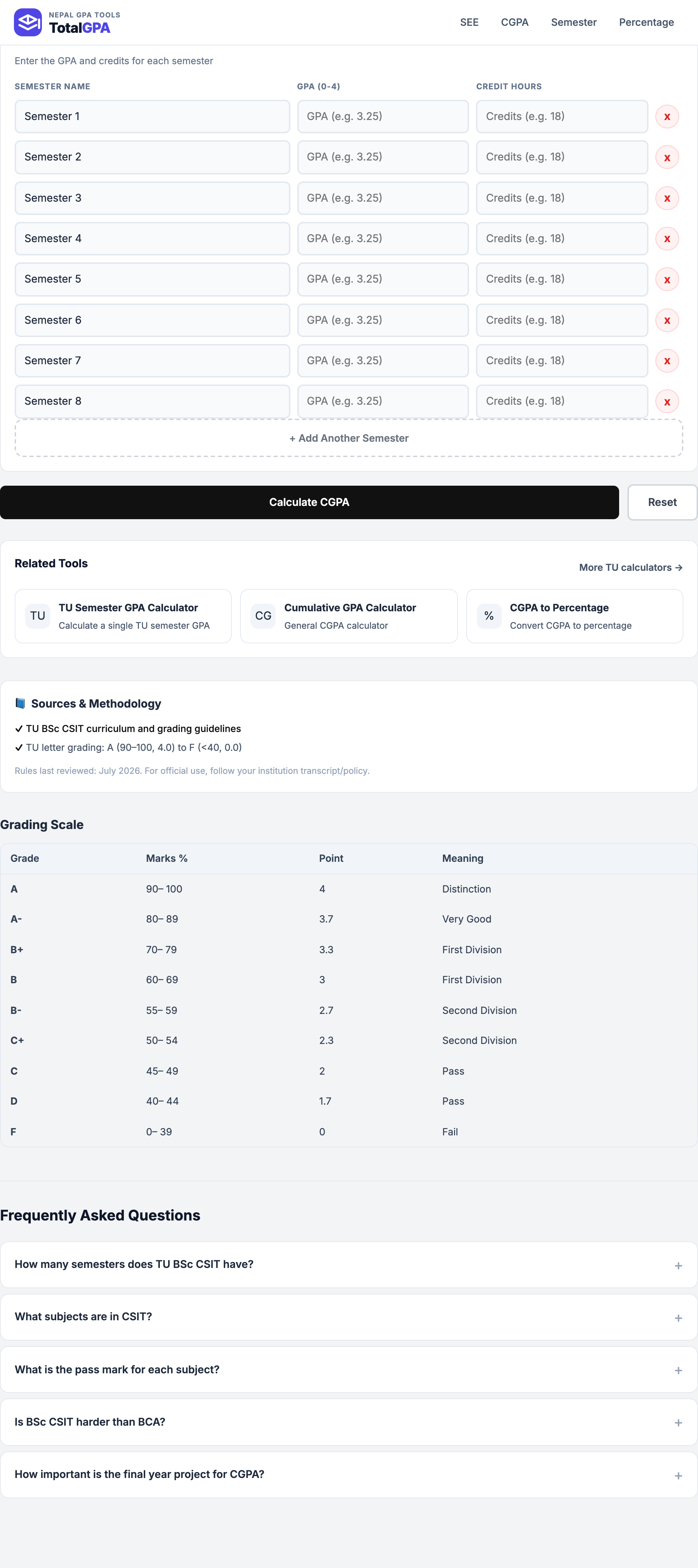
TU Grading Scale (4.0 Point System)
TU's unified 4.0 grading scale applies to all semester programs including BSc CSIT:
| Marks Range | Grade | Grade Point | Description |
|---|---|---|---|
| 90-100 | A | 4.0 | Outstanding |
| 80-89 | A- | 3.7 | Excellent |
| 70-79 | B+ | 3.3 | Very Good |
| 60-69 | B | 3.0 | Good |
| 55-59 | B- | 2.7 | Satisfactory |
| 50-54 | C+ | 2.3 | Acceptable |
| 45-49 | C | 2.0 | Pass |
| 40-44 | D | 1.7 | Marginal Pass |
| Below 40 | F | 0.0 | Fail |
BSc CSIT Program Overview
TU BSc CSIT is a 4-year bachelor's degree designed to produce computer science engineers. Key subjects include:
- Data Structures & Algorithms
- Object-Oriented Programming (Java, C++)
- Web Development (HTML, CSS, JavaScript, PHP)
- Database Systems (SQL, MySQL)
- Software Engineering
- Network Programming & Cybersecurity
- Mobile Application Development
- Machine Learning & AI (Advanced semesters)
SGPA and CGPA Formulas
SGPA (Semester Grade Point Average)
SGPA = Σ(Grade Point × Credit Hours) / Σ(Credit Hours)
CGPA (Cumulative Grade Point Average)
CGPA = Σ(All Grade Points × Credit Hours) / Σ(All Credit Hours)
BSc CSIT Division Criteria
- First Division: CGPA 3.6 and above
- Second Division: CGPA 3.2 to 3.59
- Third Division: CGPA 2.8 to 3.19
- Pass: CGPA 2.0 to 2.79
Understanding Credit Hours
In BSc CSIT, courses range from 2-4 credit hours. Understanding their importance:
- Theory courses: Usually 3-4 credit hours
- Lab/Practical courses: Usually 2-3 credit hours
- Higher credit courses impact CGPA more heavily
📊 Use Our BSc CSIT CGPA Calculator
With 8 semesters and multiple courses per semester, manual CGPA calculation is impractical. Our dedicated TU BSc CSIT CGPA Calculator automates the entire process:
Strategies to Maintain High CGPA in CSIT
- Master Core Courses: Data Structures, OOP, and Algorithms are foundational – prioritize
- Active Lab Participation: Labs account for ~40% of course marks
- Build Projects: Quality projects improve marks and build your portfolio
- Consistent Learning: Maintain effort from Semester 1; catch up in later semesters is harder
- Study Groups: CSIT is challenging; study with peers to understand difficult concepts
Common CSIT CGPA Questions
Q: Can I retake courses to improve CGPA?
Retake and grade-replacement rules can vary by program, campus, and notice. Confirm the current rule before assuming a retake will replace an earlier grade.
Q: How do I balance CGPA with learning practical skills?
Coursework covers fundamental theory. Supplement it with personal projects on GitHub, contribute to open-source, and take online courses (Coursera, freeCodeCamp) for advanced skills.
Note: Track your CGPA every semester with the calculator, then verify final reporting rules with your campus or transcript policy.