
How to Calculate CGPA for TU MBA Students
Comprehensive guide to Tribhuvan University Master of Business Studies (MBA/MBS) GPA and CGPA calculation.
TU's MBA (Master of Business Studies/MBS) program is designed for professionals seeking advanced business management expertise. Your CGPA is an academic record that may be reviewed for applications, but exact criteria vary by program and organization.
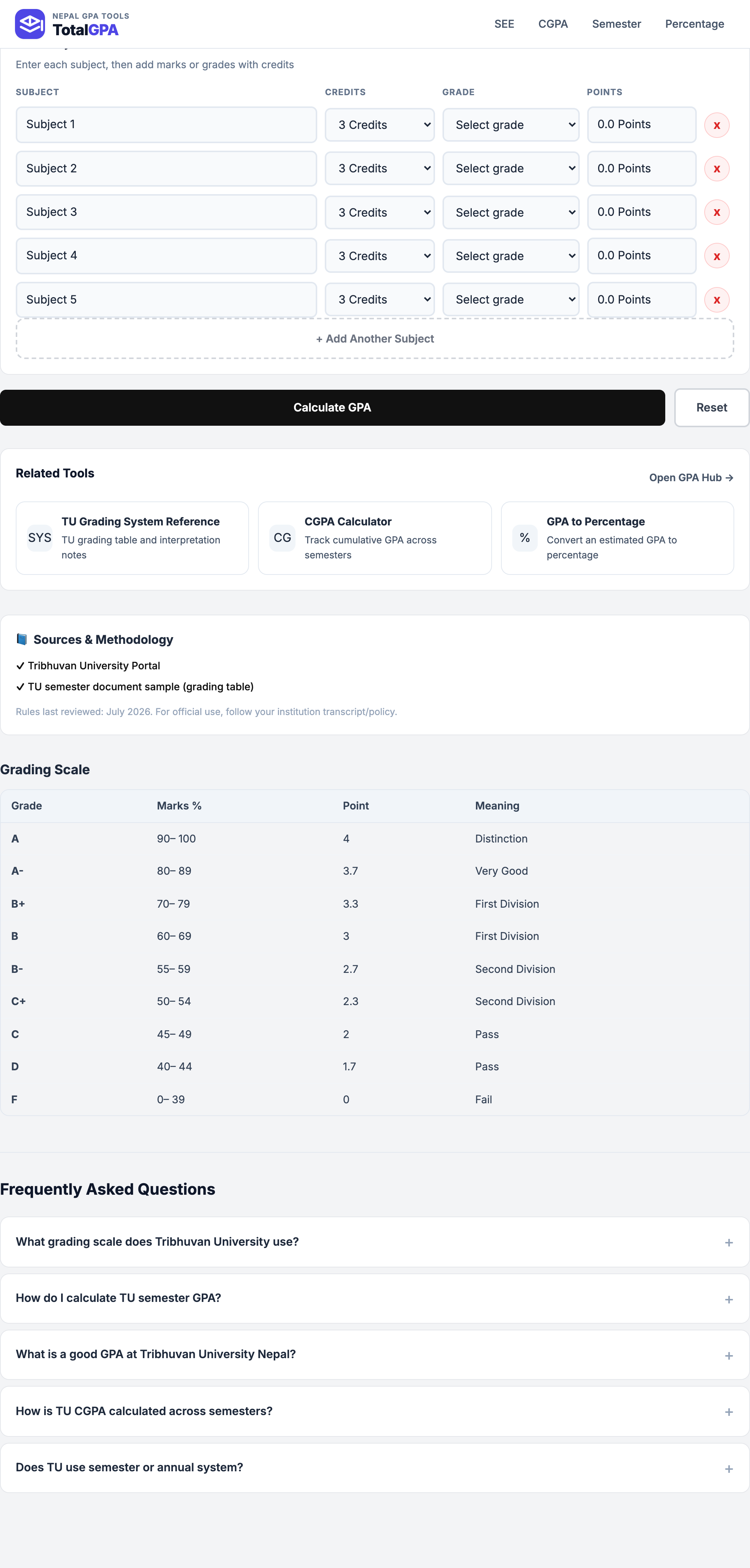
TU MBA Grading Scale
TU MBA follows the same 4.0-point grading scale as undergraduate programs:
| Marks Range | Grade | Grade Point | Description |
|---|---|---|---|
| 90-100 | A | 4.0 | Outstanding |
| 80-89 | A- | 3.7 | Excellent |
| 70-79 | B+ | 3.3 | Very Good |
| 60-69 | B | 3.0 | Good |
| 55-59 | B- | 2.7 | Satisfactory |
| 50-54 | C+ | 2.3 | Acceptable |
| 45-49 | C | 2.0 | Pass |
| 40-44 | D | 1.7 | Marginal Pass |
| Below 40 | F | 0.0 | Fail |
MBA Program Structure
TU MBA is typically a 2-year master's program with focus areas including:
- Financial Management
- Marketing Management
- Human Resource Management
- Operations & Supply Chain Management
- Business Strategy & Entrepreneurship
- International Business
- Research Methods & Thesis
SGPA and CGPA Calculation
SGPA (Semester Grade Point Average)
SGPA = Σ(Grade Point × Credit Hours) / Σ(Credit Hours)
CGPA (Cumulative Grade Point Average)
CGPA = Σ(All Grade Points × Credit Hours) / Σ(All Credit Hours)
Example for a 2-Semester MBA:
- Semester 1: SGPA 3.6 (40 credit hours)
- Semester 2: SGPA 3.4 (40 credit hours)
- CGPA = (3.6 + 3.4) / 2 = 3.5
MBA Division/Honors at TU
- Distinction: CGPA 3.7 and above
- First Class: CGPA 3.5 to 3.69
- Upper Second Class: CGPA 3.2 to 3.49
- Second Class: CGPA 2.8 to 3.19
- Pass: CGPA 2.0 to 2.79
Credit System in MBA
MBA courses typically carry 3-4 credit hours each. Credit hours represent the academic weight of a course – higher credit courses have greater impact on your CGPA. Choose your electives strategically based on your strengths.
📊 Use Our MBA CGPA Calculator
With fewer semesters than undergraduate programs, each course is weighted more heavily in MBA. Our dedicated TU MBA CGPA Calculator simplifies tracking:
Why MBA CGPA Matters
CGPA is one part of your academic profile. It is often included in applications, but different organizations and programs apply their own criteria. Use this guide to understand how your TU MBA CGPA is calculated and to track your progress.
Strategies for High MBA CGPA
- Course Selection: Choose electives aligned with your expertise – be strategic
- Thesis/Capstone Project: Often weighted heavily – allocate significant time
- Participation: Class participation & case discussions matter in MBA evaluation
- Peer Network: MBA is as much about networking as academics – engage actively
- Time Management: Balance full-time work with MBA studies effectively
Common MBA CGPA Questions
Q: Is retaking courses allowed in MBA?
Yes, TU allows course retakes in MBA. The higher score replaces the lower one in CGPA calculation. If you score below 2.7, consider retaking for GPA improvement and better learning.
Q: How should I use MBA CGPA after graduation?
Use your CGPA as one part of your academic record. Employers, institutions, and notices may also consider interviews, experience, skills, and official documents, so CGPA alone does not guarantee any outcome.
Q: Can I improve MBA CGPA after graduation?
No, CGPA is final at graduation. During your MBA, maintain consistent effort to achieve the best possible CGPA.
🎓 Pro Tip: Use our calculator from your first semester to monitor your trajectory toward your target CGPA. A strong first semester sets positive momentum for your entire MBA journey!